
The Krewelings · Calm Corner & One-to-One
The Emotion Card Deck
Forty-five two-sided cards. One side speaks to the child. The other side speaks to you. All twenty Krewelings, roughly 360 coping tips, and four story prompts — small enough to live in a basket in the calm corner.
One card. Two audiences.
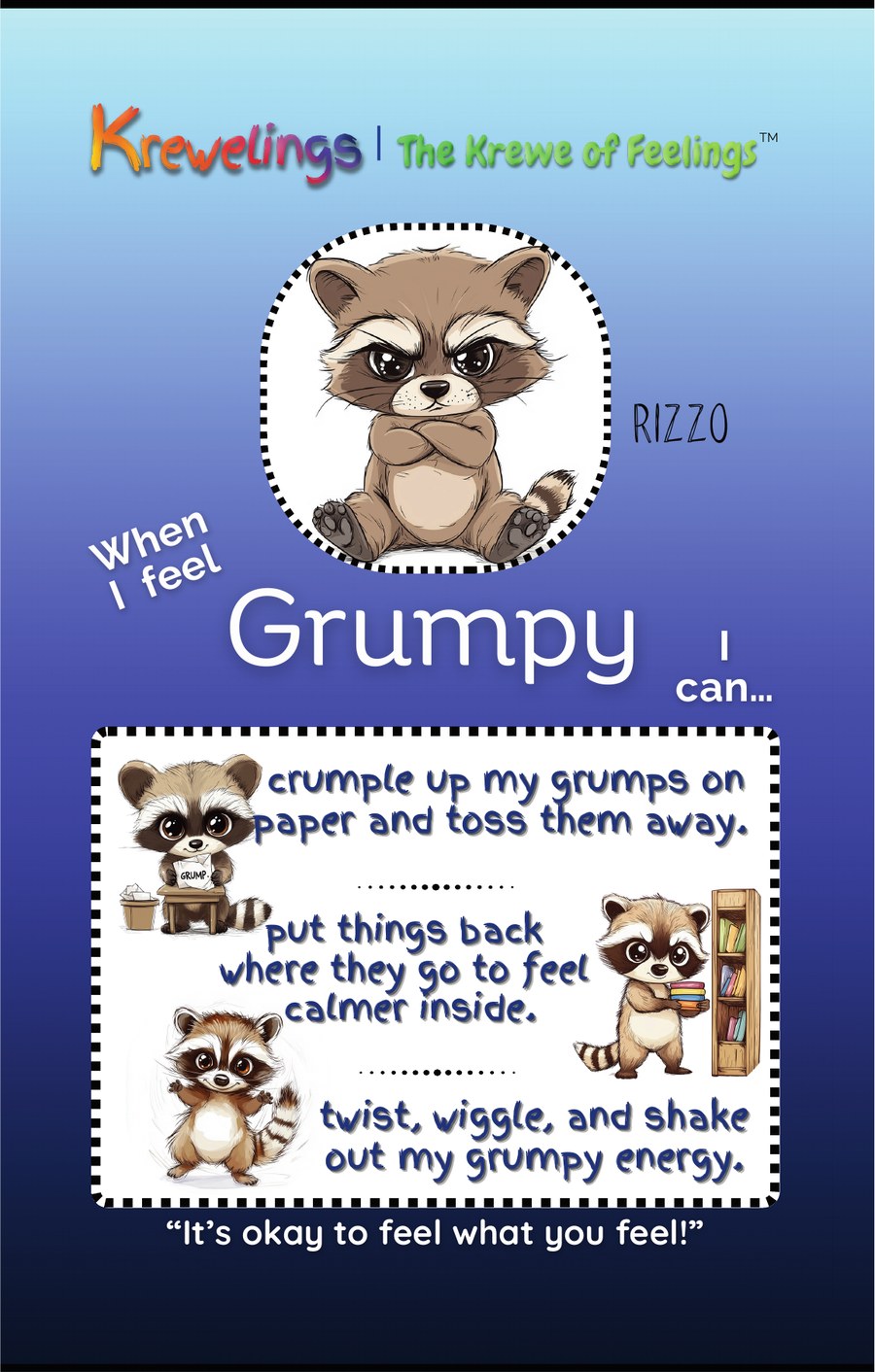
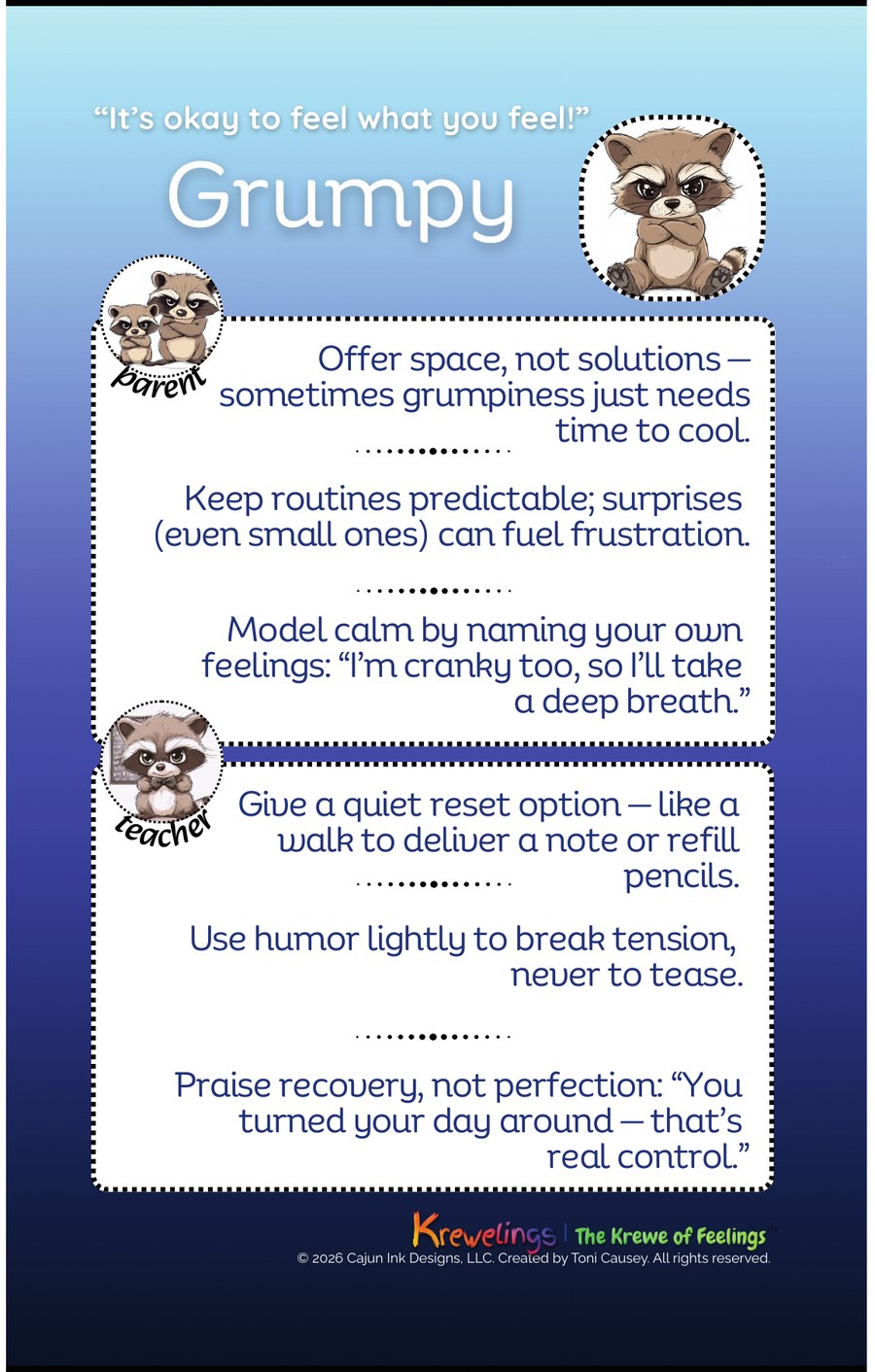
This is the part most feelings decks skip. The child gets three things they can actually do — in their own words. Flip the card, and the grown-up gets six more: three written for home, three written for the classroom. Here is Rizzo the raccoon, feeling grumpy, front and back.
The child side
Every card opens the same way: “When I feel ___, I can…” — then three illustrated strategies a small child can do without help. Rizzo’s are: crumple up my grumps on paper and toss them away · put things back where they go to feel calmer inside · twist, wiggle, and shake out my grumpy energy.
Every child side closes with the same line: “It’s okay to feel what you feel!”
The grown-up side
Split in half, with its own little icon for each: a Parent section and a Teacher section — and the advice is genuinely different, because a kitchen at 6pm is not a classroom at 10am.
Parent: “Offer space, not solutions — sometimes grumpiness just needs time to cool.”
Teacher: “Give a quiet reset option — like a walk to deliver a note or refill pencils.”
Where the ~360 tips come from
Nine tips on every character card — counted, not estimated.
On the front
3 for the child
Kid-executable strategies in kid language, with a picture for each one.
On the back
3 for the parent
What helps at home, at bedtime, in the car, in the middle of a hard evening.
On the back
3 for the teacher
What helps with twenty other children in the room and a lesson to finish.
20 characters × 2 cards each = 40 character cards. 40 cards × 9 tips = roughly 360 coping tips in one deck.
What’s in the box — well, in the wrap
Forty-five cards, printed both sides, and no wasted card.
Character cards
Two per Kreweling — a different set of child tips and a different set of parent and teacher tips on each, so a child who has worn out one card has somewhere new to go.
Story-prompt cards
Open-ended scenes for circle time or the dinner table, each tagged to an SEL skill: A Moment of Courage · A Mixed-Up Feelings Day · A Surprise Visitor · A Feeling Starts Small.
Guide card
How to use the deck, what SEL is and why it matters, and a QR code for a free printable pack — six coloring pages, two activity pages, and a mini-poster.
The story prompts do something the tip cards can’t
Four bonus cards that hand the feeling to the child instead of the other way round. Here is A Mixed-Up Feelings Day, in full:
One of the Krewelings wakes up with TWO feelings at the same time. Pick the feelings… okay, now…
- What does each feeling make their body or face do?
- Which feeling shows up first, and which one comes next?
- Does the friend try to hide the feelings, or talk to someone?
- What helps the feelings calm down or work together?
Tell the story of what happens…
SEL skill: emotional complexity and self-awareness
The other three: A Feeling Starts Small (emotional awareness & regulation) · A Surprise Visitor (empathy & social connection), where Obie the owl turns up as a guest · A Moment of Courage (confidence & courageous choices).
This is where emotional literacy quietly turns into storytelling — children start noticing why characters do what they do.
Practical details
Size and packaging
Each card is 3.5″ × 5.5″ — big enough for a child to hold and read the pictures, small enough to sit in a basket in the calm corner or travel home in a backpack. The deck ships as a set in a clear cellophane wrap.
We skipped the rigid box on purpose. Teachers told us it would end up in a zip bag anyway.
How teachers actually use it
Home base is a basket in the calm corner. Pull one card for a whole-group check-in, hand one to a child who needs a minute, or let a child choose the character that matches their day. Each of the workbook’s deep-dive spreads carries a Krewe Connection line pointing to the right card for that lesson.
A note on what this is
Printed on the guide card, and worth repeating here: this deck is not a medical, therapeutic, or diagnostic tool. It is an educational resource designed to support emotional learning at home and in the classroom.
The deck is ready to ship
Every one is printed for your order. $29.99, plus $11.95 flat-rate shipping.
Buy now · $29.99 → For schools & classrooms