
The Krewelings · Teacher & Home Resource
The Teacher’s Workbook
Eighty full-color pages of daily check-in routines, reproducible classroom tools, and one deep-dive spread for every single feeling in the Krewe. Built for PreK–2nd grade — and built for the day it goes wrong.
Reviewed by a clinician
Before this workbook went to print, a licensed psychotherapist with 30 years in practice spent more than a week with it, page by page. She recommends it.
— Susan Ward, LCSW
Six sections. No wrong entry point.
The workbook is deliberately non-linear — color-coded and marked with A–F letter tabs so you can flip straight to what your classroom needs most right now. There’s no wrong entry point: the right page is whichever one your children need today.
Quick Start Guide
The daily check-in routine, your classroom setup checklist, calm-corner how-to, and a first-week script for introducing the Krewe.
Routine Masters
Eight reproducible daily and weekly tools — feelings check-ins, a body-clues map, a tracker for you, and a note that goes home.
Emotion Deep Dive
One two-page spread per character, all twenty, across four units. A teacher reference page plus a child activity page for every feeling.
Family Connection
A ready-to-send parent letter, a fridge-sized Meet the Krewe for home, and simple ideas families can actually use.
Certificate
An “I Grew My Krewe!” award you can print as many times as you need — designed to mark effort, not just outcomes.
Resources
The CASEL framework, four books for educators and caregivers, and four children’s books that pair with the Krewe.
How it actually works
Everything in the workbook hangs off one four-step routine — and the same four steps live on the Calm Corner poster, while the TOOL IT step is printed right on the front of every card — so the whole system speaks one language.
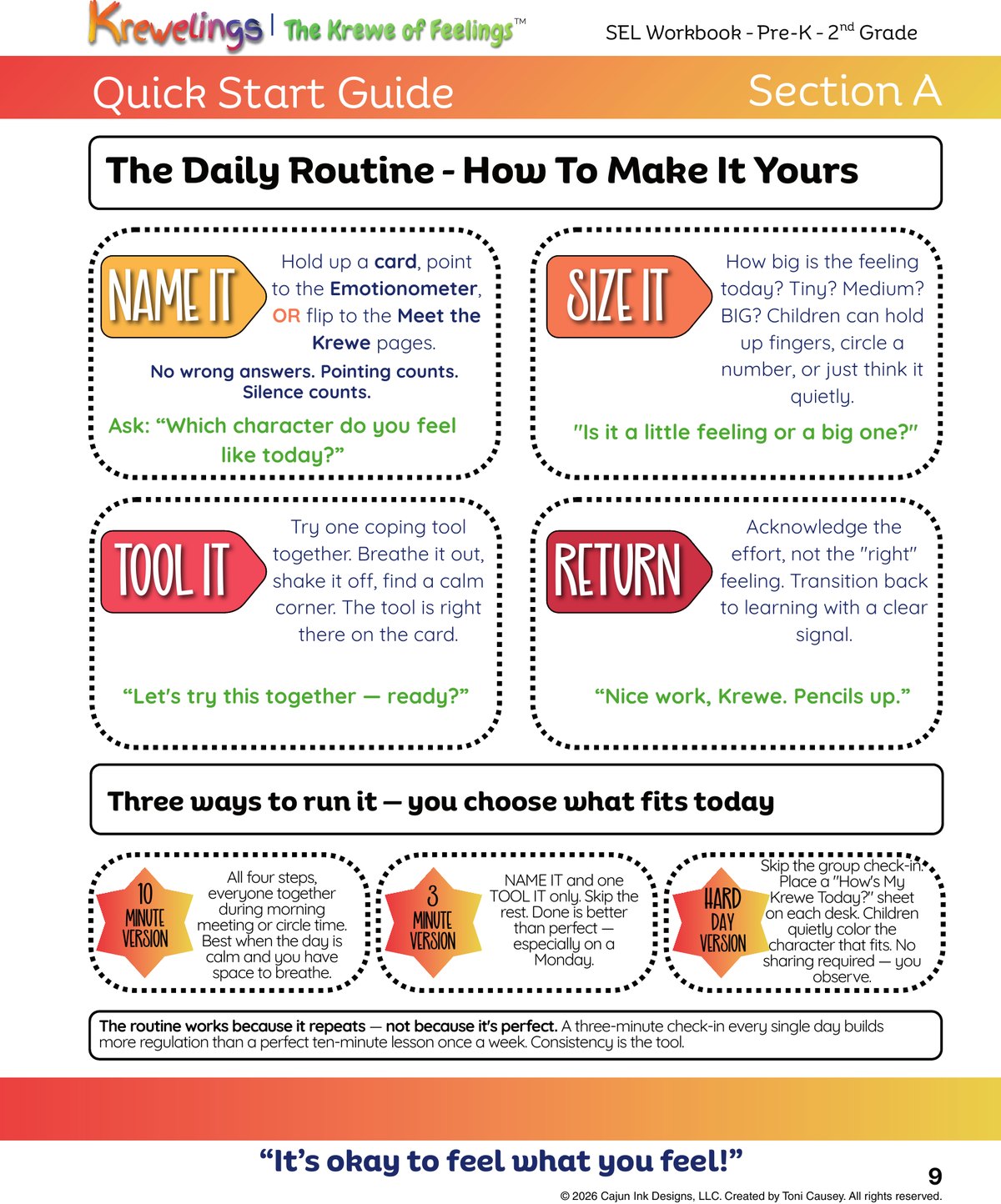
Name it → Size it → Tool it → Return
- 1NAME IT Hold up a card, point to the Emotionometer, or flip to Meet the Krewe. “Which character do you feel like today?” No wrong answers. Pointing counts. Silence counts.
- 2SIZE IT How big is the feeling? Tiny? Medium? BIG? Children hold up fingers, circle a number, or just think it quietly.
- 3TOOL IT Try one coping tool together — breathe it out, shake it off, find a calm corner. The tool is right there on the card.
- 4RETURN Acknowledge the effort, not the “right” feeling, then a clear transition signal: “Nice work, Krewe. Pencils up.”
Every step comes with a script, because the hardest part of a new routine is knowing what to say first.
Three ways to run it — you choose what fits today
Printed on page 9. The same routine, three lengths, so it survives a real week.
When the day is calm
10-minute version
All four steps, everyone together during morning meeting or circle time. Best when you have space to breathe.
When you’re short on time
3-minute version
Name It and one Tool It only. Skip the rest. Done is better than perfect — especially on a Monday.
When it all goes sideways
Hard-day version
Skip the group check-in entirely. Put a “How’s My Krewe Today?” sheet on each desk. Children quietly color the character that fits. No sharing required — you observe.
“The routine works because it repeats — not because it’s perfect. A three-minute check-in every single day builds more regulation than a perfect ten-minute lesson once a week. Consistency is the tool.”
The routine pages are a toolkit, not a to-do list
Section B holds eight reproducible masters. You are not expected to use all of them — and the workbook says so, out loud, right at the top of the section.
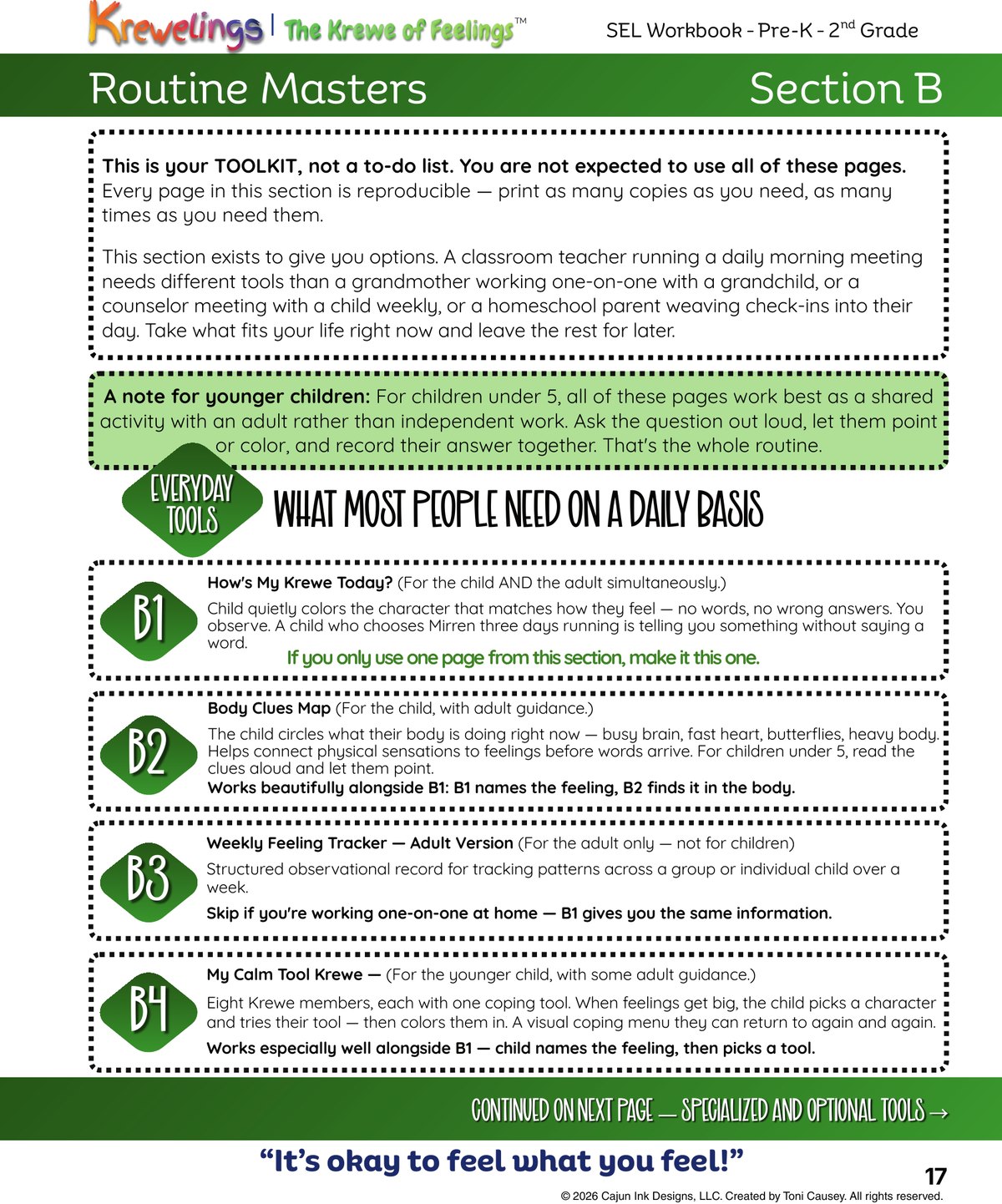
“This is your TOOLKIT, not a to-do list. You are not expected to use all of these pages. Every page in this section is reproducible — print as many copies as you need, as many times as you need them.”
The section sorts itself for you: four everyday tools most people need daily, and four specialized and optional ones you can use or skip. Each page tells you who it’s for — the child, the adult, or both — and what to do if you only have room for one.
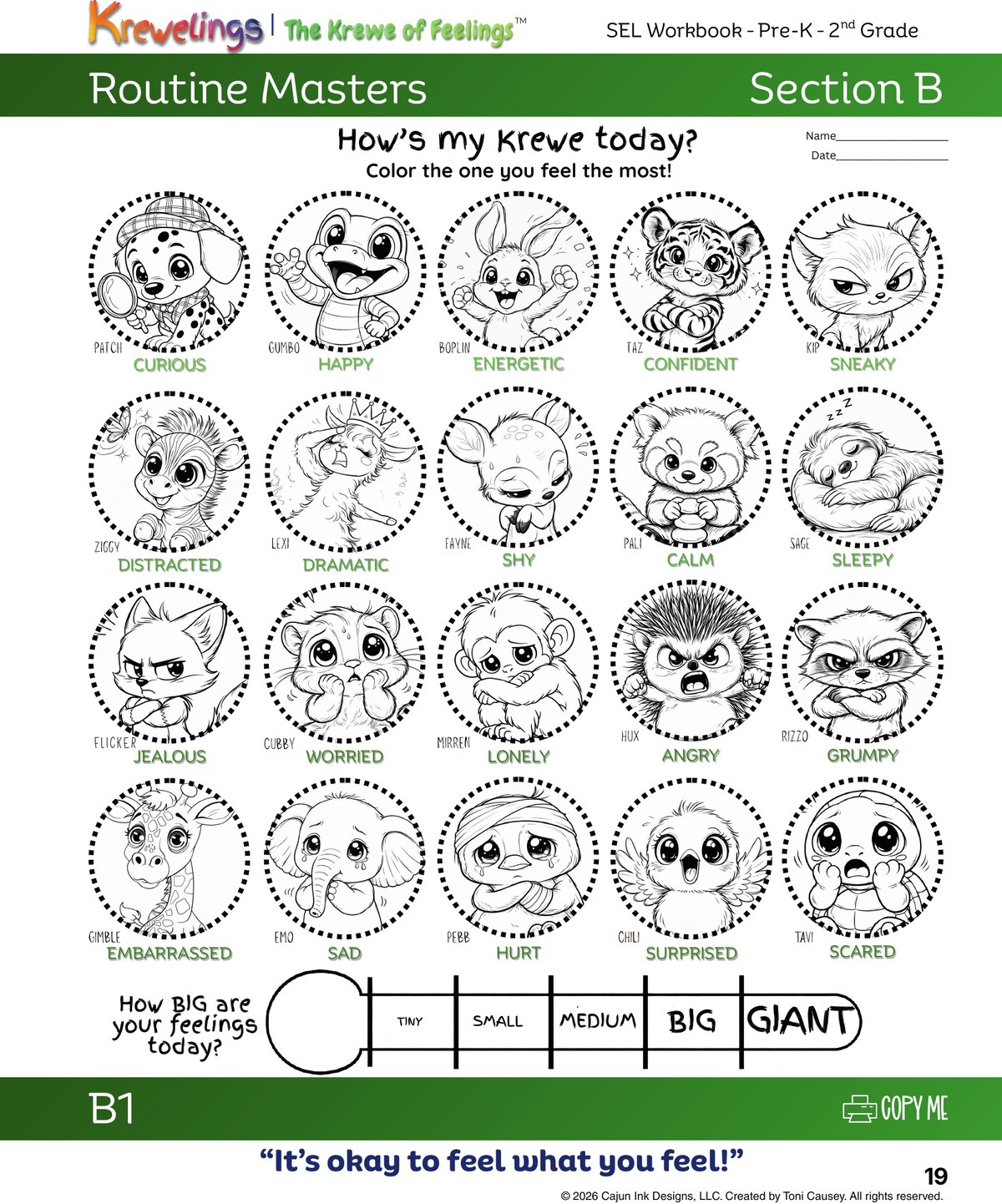
- B1 · How’s My Krewe Today? — the daily check-in. “If you only use one page from this section, make it this one.”
- B2 · Body Clues Map — B1 names the feeling; B2 finds it in the body.
- B3 · Weekly Feeling Tracker — for the adult only, to spot patterns across a week.
- B4 · My Calm Tool Krewe — a visual coping menu children return to again and again.
- B5 · My Best Moment This Week · B6 · My Calm Corner Plan · B7 · Circle Discussion Prompts · B8 · Family Connection Note
Every feeling gets its own spread
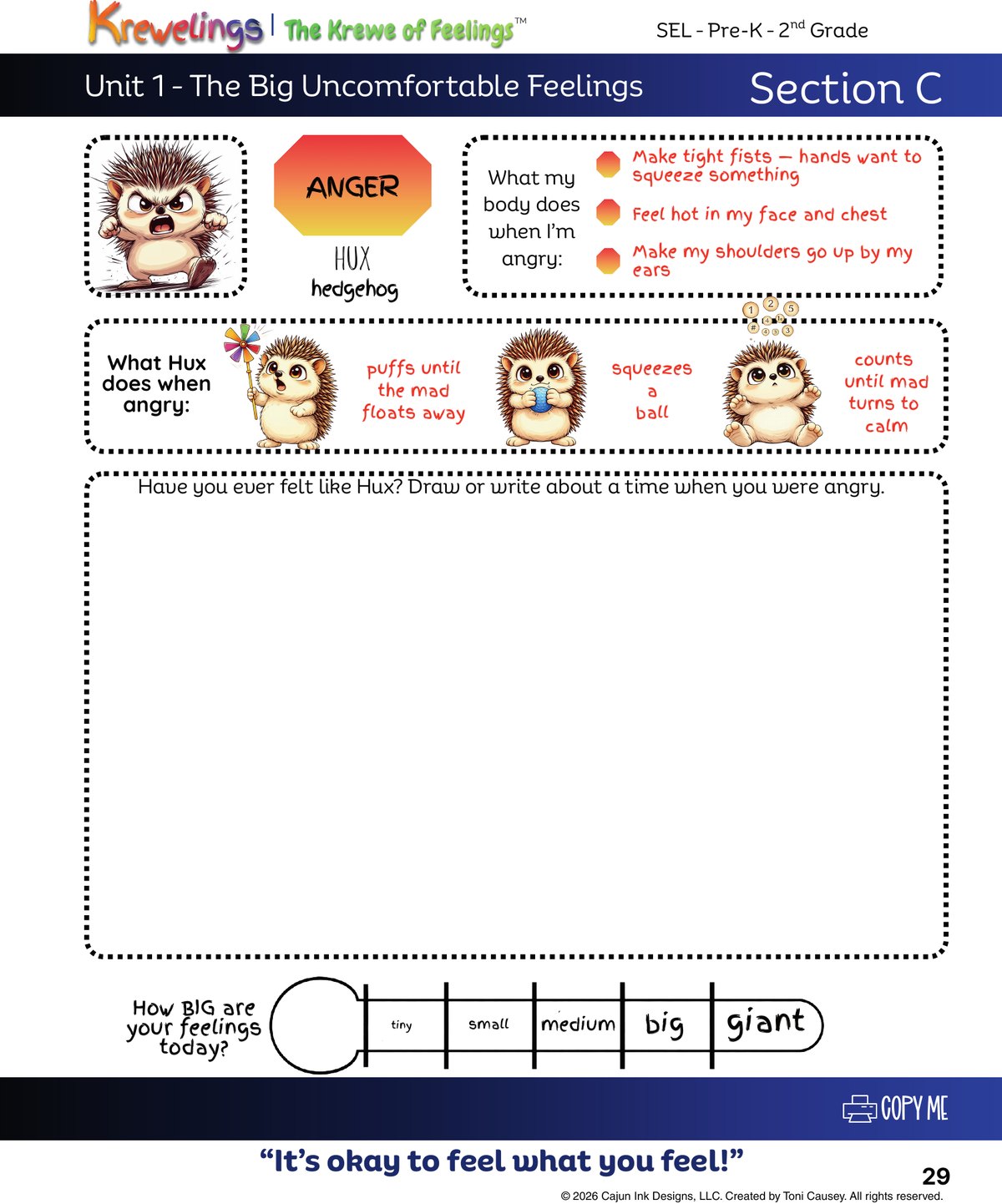
Section C is the heart of the book: twenty two-page spreads, one for each Kreweling, grouped into four units. The left page is written for you. The right page is written for the child.
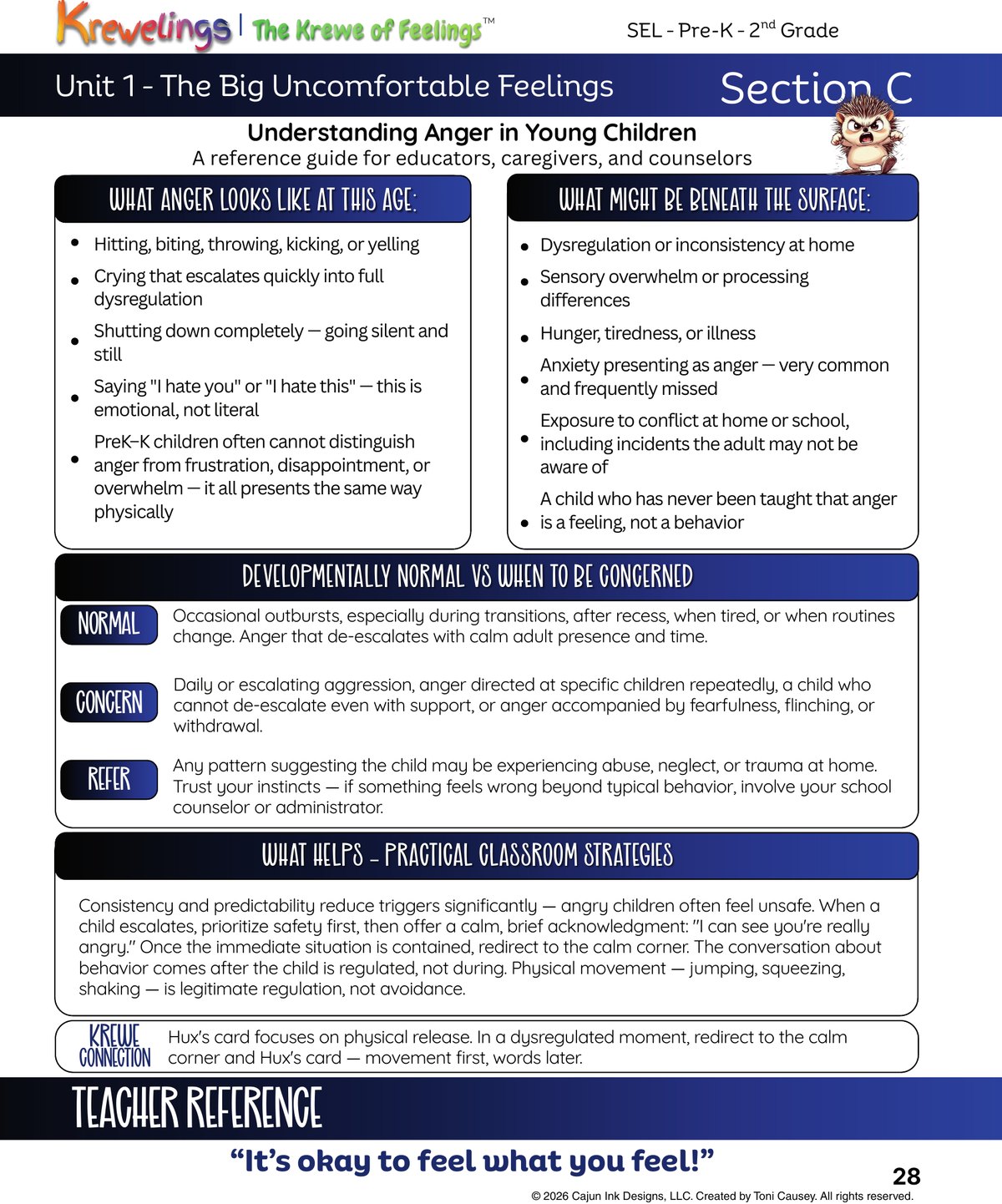
The teacher reference page
What the feeling looks like at this age · what might be underneath it · developmentally normal vs. when to be concerned · practical classroom strategies · and a Krewe Connection line telling you exactly which card to reach for.
These pages are general educational guidance, not clinical assessment — the workbook says so in plain language on the copyright page.
The child activity page — it grows with them
Three body clues to circle, three of that character’s coping tools, a feeling-size scale, and an open prompt: “Have you ever felt like Hux? Draw or write about a time when you were angry.”
A three-year-old colors it. A five-year-old draws it. A seven-year-old writes the story. Same page, three years of use — and it’s reproducible, so you print a fresh one every time.
The four units: The Big Uncomfortable Feelings · The Socially Complex Feelings · The Self-Awareness Feelings · The Feel-Good Feelings.
A whole section that goes home
Section D · Family Connection
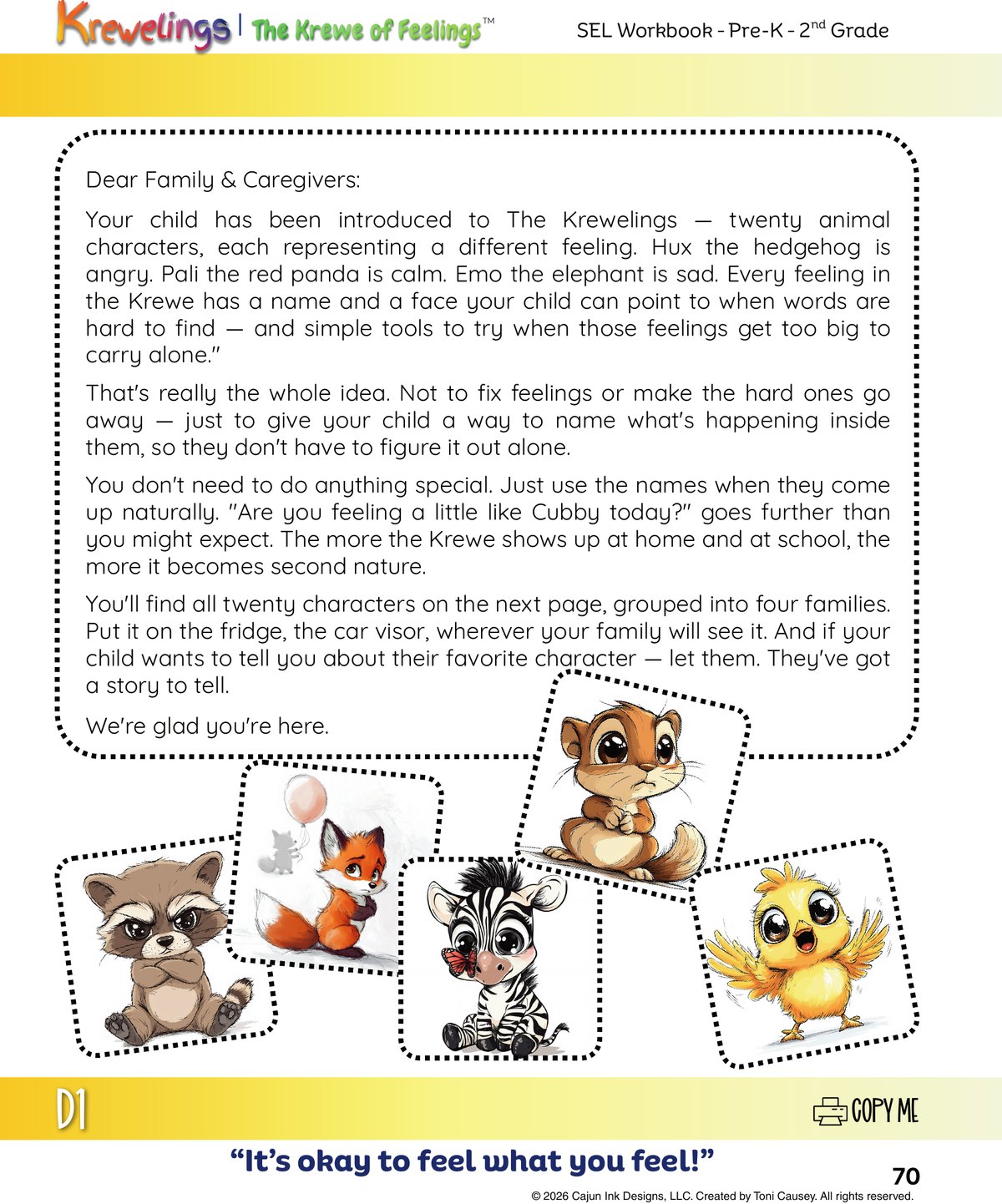
Written to be sent, not just read. A ready-to-use parent welcome letter you can print as-is or personalize; a scaled-down Meet the Krewe: Home Edition made for the fridge or the car visor; and Try This At Home — eight low-effort ideas that work in the grocery line or right before lights out.
“The more the Krewe shows up in both places, the faster children develop the habit of naming what they feel — and reaching for a tool instead of acting out.”
The letter is deliberately written to land with single parents, grandparents, foster families, and non-English-speaking households — and the section is honest that not every family will engage: “You don’t need 100% family participation for this to be effective in your classroom.”
And yes — there’s a certificate
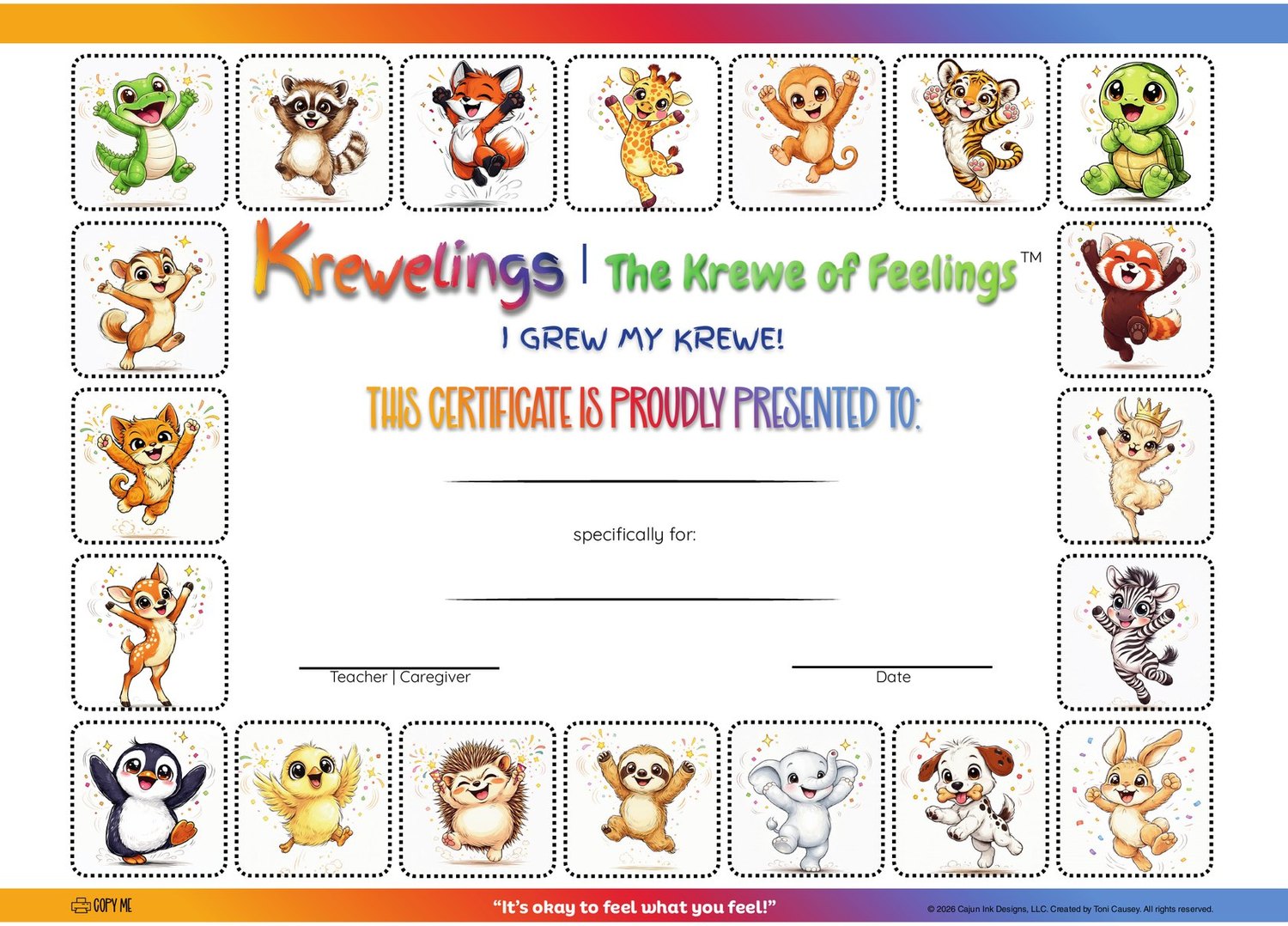
Ringed with all twenty characters, reproducible, and meant to be used throughout the year rather than saved for the end of it. The guidance that comes with it is specific: recognize effort, not just outcomes. A child who tried a calm-corner tool even once deserves acknowledgment.
Let the child pick which Kreweling appears on theirs, or color it in themselves. Print as many as you need.
Tear a page? Print another one.
Every reproducible page carries a COPY ME printer icon — and your purchase includes a downloadable set of the Copy Me pages, accessed by the personal link in your confirmation email — plus a set of bonus routine pages that aren’t printed in the book at all, via the QR code inside the cover. If a page gets torn, spilled on, or you simply need thirty more, you re-print it. No re-buying the book.
The download set is licensed to the one classroom or home that bought the workbook. Reference pages, section intros, and anything without the COPY ME icon stay in the book.
It doesn’t work alone — but it does work alone
You don’t need the deck to use the workbook. But every deep-dive spread carries a Krewe Connection line telling you exactly which card to reach for — and the Emotionometer the routine points to is one of the posters.
How it maps to the CASEL framework
A two-page map — not a curriculum — showing where the daily routine, the eight routine masters and all twenty units sit against CASEL’s five core competencies. Free to download and hand to your principal or counselor.
Download the CASEL map (PDF) →The workbook is ready to ship
Every one is printed for your order. $44.99, plus $11.95 flat-rate shipping.
Buy now · $44.99 → For schools & classrooms